> ## Documentation Index
> Fetch the complete documentation index at: https://docs.didit.me/llms.txt
> Use this file to discover all available pages before exploring further.
# Device & IP analysis warnings
> Every Device & IP analysis warning code: VPN/Tor, country mismatch, blocklists, duplicate IP/device, recovered devices, and expected-IP mismatch.
export const WarningTypes = () =>
{WARNING_TYPES.map(w =>
)}
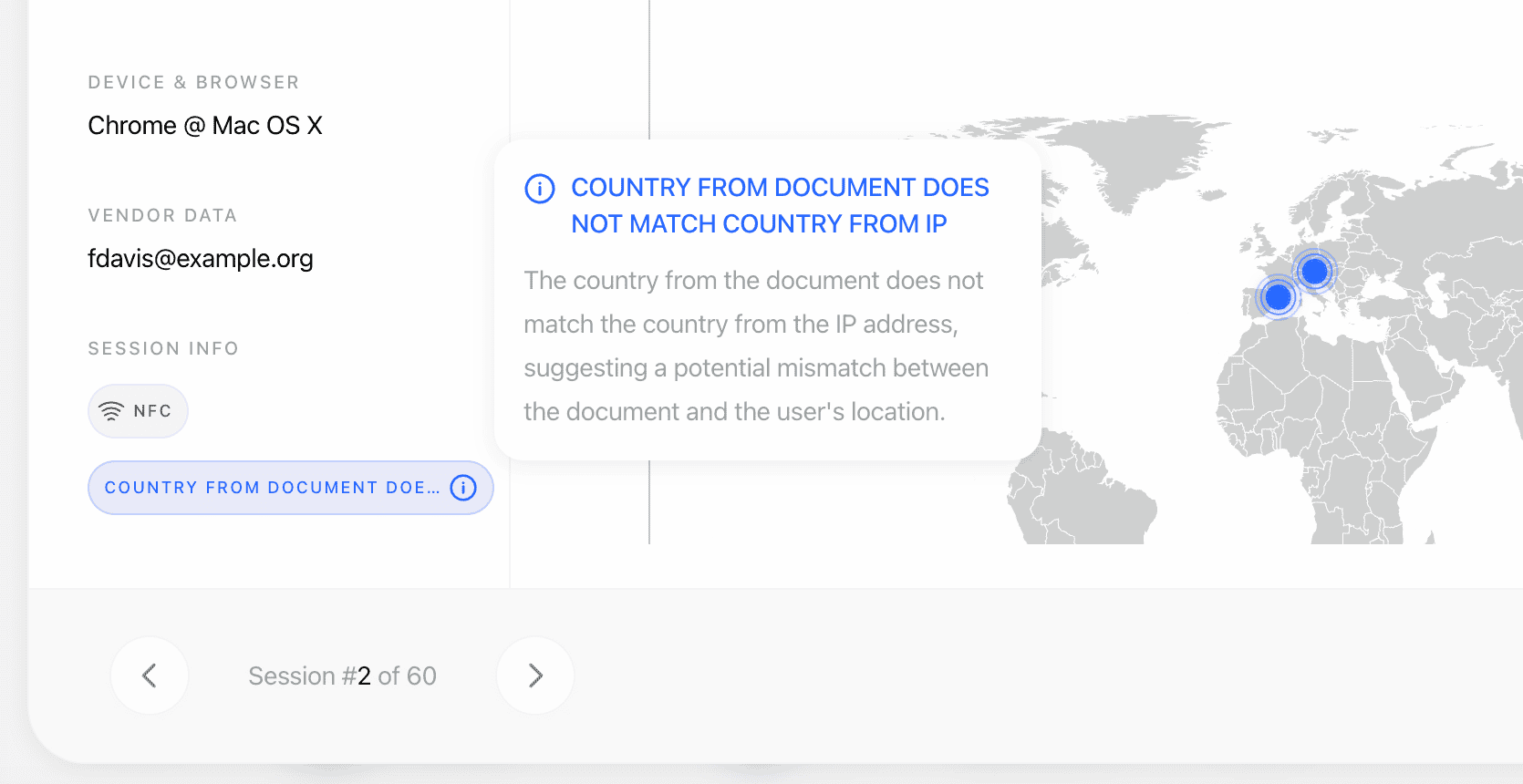 ## Warnings produced
| Risk | Cause | `log_type` | Affects status | Recommended remediation |
| ------------------------------------------------------ | ---------------------------------------------------------------------------------------------------------------------------------------------------------------------------------------------------------------------------------------------------------------------------------------------------------------------------------------------------------------- | ------------------------- | ---------------------------------------------------------------- | ------------------------------------------------------------------------------------------------------------------------------------ |
| `PRIVATE_NETWORK_DETECTED` | `is_vpn_or_tor` was `true` — the session was opened via VPN, proxy, or Tor exit node. `additional_data` is `null`. | mirrors configured action | Configurable: Decline / Review / No action (default: No action). | Decide whether your risk tolerance allows masked traffic. If you accept it, leave on No action. |
| `COUNTRY_FROM_DOCUMENT_DOES_NOT_MATCH_COUNTRY_FROM_IP` | The ISO country of the ID document differs from the country derived from the IP address. `additional_data` carries both ISO-3 codes: `document_country_code`, `ip_country_code`. | mirrors configured action | Configurable: Decline / Review / No action (default: No action). | Review when the user travels legitimately. Decline when paired with VPN or duplicate-device signals. |
| `EXPECTED_IP_ADDRESS_MISMATCH` | The session was created with an expected IP address, and the live IP differs. `additional_data` carries `expected_ip_address` and `actual_ip_address`. | mirrors configured action | Configurable: Decline / Review / No action (default: No action). | Use when you pre-pin the IP at session creation. Refuse the session or step up auth on mismatch. |
| `IP_ADDRESS_IN_BLOCKLIST` | The session's IP address matches an entry in the application's IP blocklist. `additional_data`: `ip_address`. | always `error` | Forces `Declined`. | Reject the session. Audit the blocklist source for false positives if needed. |
| `DEVICE_FINGERPRINT_IN_BLOCKLIST` | The session's device fingerprint matches an entry in the device blocklist. `additional_data`: `device_fingerprint`. | always `error` | Forces `Declined`. | Reject the session. |
| `IP_ADDRESS_IN_ALLOWLIST` | The session's IP had duplicate matches but is on the application's IP allowlist, so the duplicate-IP warning was skipped. `additional_data`: `ip_address`. | always `information` | None. | Use for trusted corporate NATs, QA networks, or known shared access points. |
| `DEVICE_FINGERPRINT_IN_ALLOWLIST` | The session's device fingerprint had deterministic duplicate matches but is on the device allowlist, so the duplicate-device warning was skipped. `additional_data`: `device_fingerprint`. | always `information` | None. | Use only for trusted shared devices. Blocklists still take priority. |
| `DUPLICATED_IP_ADDRESS` | The same IP was used in another session with a different `vendor_data`. `additional_data`: `duplicated_session_id`, `duplicated_session_number`, `api_service`. Skipped when the IP is allowlisted. | mirrors configured action | Configurable: Decline / Review / No action (default: No action). | Common on corporate or shared NAT. Pair with other signals (duplicate device, country mismatch) before declining. |
| `DUPLICATED_DEVICE_FINGERPRINT` | The same deterministic device identity was reused across sessions with different `vendor_data`. `additional_data`: `duplicated_session_id`, `duplicated_session_number`, `api_service`, `match_source` (`persistent_id` or `legacy_fp`). Skipped when the fingerprint is allowlisted. | mirrors configured action | Configurable: Decline / Review / No action (default: No action). | Strong evidence of multi-account abuse. Review or decline depending on fraud tolerance. |
| `DEVICE_RECOVERED_HIGH_CONFIDENCE` | The v2 device recovery model matched the session to a previously seen device with high confidence, even after the persistent ID changed. `additional_data`: `duplicated_session_id`, `duplicated_session_number`, `api_service`, `match_source` (`recovered_high`), `recovery_similarity`, `recovery_match_device_uuid`. Not suppressed by the device allowlist. | mirrors configured action | Configurable: Decline / Review / No action (default: No action). | Start with Review, measure your false-positive rate, then tighten the action. Strong signal for storage-reset or incognito attempts. |
When the recovered device has no eligible sibling sessions yet (so nothing lands in `matches[]`), `DEVICE_RECOVERED_HIGH_CONFIDENCE` still fires with a fallback `additional_data` shape: `recovery_match_device_uuid`, `recovery_match_similarity`, `recovery_match_band`, `recovery_gate_reason`.
## Configurable settings
Per-node workflow controls (also configurable globally on the application's verification settings; every action defaults to **No action**):
| Setting | Drives | Default |
| ----------------------------- | ------------------------------------------------------ | --------- |
| `vpn_detection_action` | `PRIVATE_NETWORK_DETECTED` | No action |
| `ip_mismatch_action` | `COUNTRY_FROM_DOCUMENT_DOES_NOT_MATCH_COUNTRY_FROM_IP` | No action |
| `expected_ip_mismatch_action` | `EXPECTED_IP_ADDRESS_MISMATCH` | No action |
| `duplicated_ip_action` | `DUPLICATED_IP_ADDRESS` | No action |
| `duplicated_device_action` | `DUPLICATED_DEVICE_FINGERPRINT` | No action |
| `recovered_device_action` | `DEVICE_RECOVERED_HIGH_CONFIDENCE` | No action |
IP and device allowlists suppress only the exact duplicate-IP or deterministic duplicate-device warning for the allowlisted value. They do not suppress VPN/proxy, country mismatch, expected-IP mismatch, recovered-device, or blocklist warnings.
Recovered-device warnings are useful for detecting fraud rings that rotate accounts and sessions from the same hardware, but Didit is conservative by design — the system prefers missing some duplicate users over merging unrelated devices when the evidence is not strong enough. **Recommended rollout**: start with Review, watch the volume for two weeks, then tighten the action if your false-positive rate is low.
## Duplicate device vs. recovered device
Treat the two warnings differently — they trigger on different evidence:
| Warning | Trigger | Typical meaning | Recommended first action |
| ---------------------------------- | -------------------------------------------------------------------------------------------------- | ---------------------------------------------------------------------------------------------------------------------------------- | -------------------------------------------------------------------- |
| `DUPLICATED_DEVICE_FINGERPRINT` | Exact persistent device identity (`persistent_id`) or legacy fingerprint hash (`legacy_fp`) match. | Strong evidence that the same device appears across different users. | Review or Decline, depending on your fraud tolerance. |
| `DEVICE_RECOVERED_HIGH_CONFIDENCE` | High-confidence v2 recovery (`recovered_high`) after storage, session, or app identity changed. | Strong signal for incognito / storage-reset / app-reinstall attempts. Intentionally separated so you can monitor it independently. | Review first, then tighten after measuring your false-positive rate. |
## Cross-session matches
When the same IP address, exact device identity, or recovered device is detected across sessions belonging to **different users**, Didit records these as `matches[]` on `ip_analyses[]`. Sessions are grouped by `vendor_data`: sessions with the same `vendor_data` are treated as the same user and excluded from matches. Without `vendor_data`, every session is treated as a unique user and all potential duplicates are surfaced — we strongly recommend always providing `vendor_data` to reduce noise.
Each match includes:
* `session_id`, `session_number`, `vendor_data`, and `verification_date` of the matching session, plus its lifecycle `status` and `api_service` (`null` for workflow sessions); `source` is always `session`
* `match_type` — `ip_address` or `device_fingerprint`
* `match_source` — `ip_address`, `persistent_id`, `legacy_fp`, or `recovered_high`
* `matched_value` — the shared IP, the device identifier, or (for recovered matches) the recovered device UUID
* `confidence` (0–1, `1 - P(false positive)`) and `match_mode` (`deterministic` / `probabilistic` / `co_occurrence`)
* `device_info` — `device_brand`, `device_model`, `browser_family`, `os_family`, `platform`, `device_fingerprint`
* `location_info` — `ip_address`, `ip_country`, `ip_country_code`, `ip_state`, `ip_city`, `is_vpn_or_tor`, `is_data_center`
* Recovered-device extras when `match_source` is `recovered_high`: `recovery_similarity`, `tls_ja4_corroborated`, `recovery_gate_reason`
IP matches and device matches are capped at 5 each (at most 10 entries). See the [report page](/core-technology/ip-analysis/report-ip-analysis#match-semantics) for the full match schema and confidence model.
## Examples
### VPN + country mismatch (configured to Review)
```json theme={null}
{
"warnings": [
{
"feature": "LOCATION",
"risk": "PRIVATE_NETWORK_DETECTED",
"additional_data": null,
"log_type": "warning",
"short_description": "Private network (VPN/Tor) detected",
"long_description": "The system detected that the user tried to use a private network (VPN/TOR) to complete the verification process.",
"node_id": "ip-1"
},
{
"feature": "LOCATION",
"risk": "COUNTRY_FROM_DOCUMENT_DOES_NOT_MATCH_COUNTRY_FROM_IP",
"additional_data": { "document_country_code": "ESP", "ip_country_code": "NLD" },
"log_type": "warning",
"short_description": "Document country does not match IP country",
"long_description": "The country from the document does not match the country from the IP address, suggesting a potential mismatch between the document and the user's location.",
"node_id": "ip-1"
}
]
}
```
### Blocklist hit (forces decline)
```json theme={null}
{
"warnings": [
{
"feature": "LOCATION",
"risk": "IP_ADDRESS_IN_BLOCKLIST",
"additional_data": { "ip_address": "45.61.20.5" },
"log_type": "error",
"short_description": "IP address in blocklist",
"long_description": "The IP address used for this session was found in the application's IP blocklist, indicating a known suspicious or forbidden origin.",
"node_id": "ip-1"
}
]
}
```
### Recovered-device high confidence (configured to Review)
```json theme={null}
{
"warnings": [
{
"feature": "LOCATION",
"risk": "DEVICE_RECOVERED_HIGH_CONFIDENCE",
"additional_data": {
"duplicated_session_id": "aaaaaaaa-bbbb-cccc-dddd-eeeeeeeeeeee",
"duplicated_session_number": 5101,
"api_service": null,
"match_source": "recovered_high",
"recovery_similarity": 0.9874,
"recovery_match_device_uuid": "f47ac10b-58cc-4372-a567-0e02b2c3d479"
},
"log_type": "warning",
"short_description": "Device matches a previously seen device with high confidence",
"long_description": "A previously seen device matched this session with high confidence through v2 fuzzy fingerprint recovery after passing strict hard gates, indicating the same physical device under a fresh persistent_id.",
"node_id": "ip-1"
}
]
}
```
## Related
* [Device & IP analysis report](/core-technology/ip-analysis/report-ip-analysis) — full response shape and status semantics
* [Device & IP analysis overview](/core-technology/ip-analysis/overview) — what each block measures
* [Data models — IP analysis](/reference/data-models#ip-analysis) — canonical schema
* [Webhooks](/integration/webhooks) — `status.updated` carries IP analysis warnings
### Warning types
## Warnings produced
| Risk | Cause | `log_type` | Affects status | Recommended remediation |
| ------------------------------------------------------ | ---------------------------------------------------------------------------------------------------------------------------------------------------------------------------------------------------------------------------------------------------------------------------------------------------------------------------------------------------------------- | ------------------------- | ---------------------------------------------------------------- | ------------------------------------------------------------------------------------------------------------------------------------ |
| `PRIVATE_NETWORK_DETECTED` | `is_vpn_or_tor` was `true` — the session was opened via VPN, proxy, or Tor exit node. `additional_data` is `null`. | mirrors configured action | Configurable: Decline / Review / No action (default: No action). | Decide whether your risk tolerance allows masked traffic. If you accept it, leave on No action. |
| `COUNTRY_FROM_DOCUMENT_DOES_NOT_MATCH_COUNTRY_FROM_IP` | The ISO country of the ID document differs from the country derived from the IP address. `additional_data` carries both ISO-3 codes: `document_country_code`, `ip_country_code`. | mirrors configured action | Configurable: Decline / Review / No action (default: No action). | Review when the user travels legitimately. Decline when paired with VPN or duplicate-device signals. |
| `EXPECTED_IP_ADDRESS_MISMATCH` | The session was created with an expected IP address, and the live IP differs. `additional_data` carries `expected_ip_address` and `actual_ip_address`. | mirrors configured action | Configurable: Decline / Review / No action (default: No action). | Use when you pre-pin the IP at session creation. Refuse the session or step up auth on mismatch. |
| `IP_ADDRESS_IN_BLOCKLIST` | The session's IP address matches an entry in the application's IP blocklist. `additional_data`: `ip_address`. | always `error` | Forces `Declined`. | Reject the session. Audit the blocklist source for false positives if needed. |
| `DEVICE_FINGERPRINT_IN_BLOCKLIST` | The session's device fingerprint matches an entry in the device blocklist. `additional_data`: `device_fingerprint`. | always `error` | Forces `Declined`. | Reject the session. |
| `IP_ADDRESS_IN_ALLOWLIST` | The session's IP had duplicate matches but is on the application's IP allowlist, so the duplicate-IP warning was skipped. `additional_data`: `ip_address`. | always `information` | None. | Use for trusted corporate NATs, QA networks, or known shared access points. |
| `DEVICE_FINGERPRINT_IN_ALLOWLIST` | The session's device fingerprint had deterministic duplicate matches but is on the device allowlist, so the duplicate-device warning was skipped. `additional_data`: `device_fingerprint`. | always `information` | None. | Use only for trusted shared devices. Blocklists still take priority. |
| `DUPLICATED_IP_ADDRESS` | The same IP was used in another session with a different `vendor_data`. `additional_data`: `duplicated_session_id`, `duplicated_session_number`, `api_service`. Skipped when the IP is allowlisted. | mirrors configured action | Configurable: Decline / Review / No action (default: No action). | Common on corporate or shared NAT. Pair with other signals (duplicate device, country mismatch) before declining. |
| `DUPLICATED_DEVICE_FINGERPRINT` | The same deterministic device identity was reused across sessions with different `vendor_data`. `additional_data`: `duplicated_session_id`, `duplicated_session_number`, `api_service`, `match_source` (`persistent_id` or `legacy_fp`). Skipped when the fingerprint is allowlisted. | mirrors configured action | Configurable: Decline / Review / No action (default: No action). | Strong evidence of multi-account abuse. Review or decline depending on fraud tolerance. |
| `DEVICE_RECOVERED_HIGH_CONFIDENCE` | The v2 device recovery model matched the session to a previously seen device with high confidence, even after the persistent ID changed. `additional_data`: `duplicated_session_id`, `duplicated_session_number`, `api_service`, `match_source` (`recovered_high`), `recovery_similarity`, `recovery_match_device_uuid`. Not suppressed by the device allowlist. | mirrors configured action | Configurable: Decline / Review / No action (default: No action). | Start with Review, measure your false-positive rate, then tighten the action. Strong signal for storage-reset or incognito attempts. |
When the recovered device has no eligible sibling sessions yet (so nothing lands in `matches[]`), `DEVICE_RECOVERED_HIGH_CONFIDENCE` still fires with a fallback `additional_data` shape: `recovery_match_device_uuid`, `recovery_match_similarity`, `recovery_match_band`, `recovery_gate_reason`.
## Configurable settings
Per-node workflow controls (also configurable globally on the application's verification settings; every action defaults to **No action**):
| Setting | Drives | Default |
| ----------------------------- | ------------------------------------------------------ | --------- |
| `vpn_detection_action` | `PRIVATE_NETWORK_DETECTED` | No action |
| `ip_mismatch_action` | `COUNTRY_FROM_DOCUMENT_DOES_NOT_MATCH_COUNTRY_FROM_IP` | No action |
| `expected_ip_mismatch_action` | `EXPECTED_IP_ADDRESS_MISMATCH` | No action |
| `duplicated_ip_action` | `DUPLICATED_IP_ADDRESS` | No action |
| `duplicated_device_action` | `DUPLICATED_DEVICE_FINGERPRINT` | No action |
| `recovered_device_action` | `DEVICE_RECOVERED_HIGH_CONFIDENCE` | No action |
IP and device allowlists suppress only the exact duplicate-IP or deterministic duplicate-device warning for the allowlisted value. They do not suppress VPN/proxy, country mismatch, expected-IP mismatch, recovered-device, or blocklist warnings.
Recovered-device warnings are useful for detecting fraud rings that rotate accounts and sessions from the same hardware, but Didit is conservative by design — the system prefers missing some duplicate users over merging unrelated devices when the evidence is not strong enough. **Recommended rollout**: start with Review, watch the volume for two weeks, then tighten the action if your false-positive rate is low.
## Duplicate device vs. recovered device
Treat the two warnings differently — they trigger on different evidence:
| Warning | Trigger | Typical meaning | Recommended first action |
| ---------------------------------- | -------------------------------------------------------------------------------------------------- | ---------------------------------------------------------------------------------------------------------------------------------- | -------------------------------------------------------------------- |
| `DUPLICATED_DEVICE_FINGERPRINT` | Exact persistent device identity (`persistent_id`) or legacy fingerprint hash (`legacy_fp`) match. | Strong evidence that the same device appears across different users. | Review or Decline, depending on your fraud tolerance. |
| `DEVICE_RECOVERED_HIGH_CONFIDENCE` | High-confidence v2 recovery (`recovered_high`) after storage, session, or app identity changed. | Strong signal for incognito / storage-reset / app-reinstall attempts. Intentionally separated so you can monitor it independently. | Review first, then tighten after measuring your false-positive rate. |
## Cross-session matches
When the same IP address, exact device identity, or recovered device is detected across sessions belonging to **different users**, Didit records these as `matches[]` on `ip_analyses[]`. Sessions are grouped by `vendor_data`: sessions with the same `vendor_data` are treated as the same user and excluded from matches. Without `vendor_data`, every session is treated as a unique user and all potential duplicates are surfaced — we strongly recommend always providing `vendor_data` to reduce noise.
Each match includes:
* `session_id`, `session_number`, `vendor_data`, and `verification_date` of the matching session, plus its lifecycle `status` and `api_service` (`null` for workflow sessions); `source` is always `session`
* `match_type` — `ip_address` or `device_fingerprint`
* `match_source` — `ip_address`, `persistent_id`, `legacy_fp`, or `recovered_high`
* `matched_value` — the shared IP, the device identifier, or (for recovered matches) the recovered device UUID
* `confidence` (0–1, `1 - P(false positive)`) and `match_mode` (`deterministic` / `probabilistic` / `co_occurrence`)
* `device_info` — `device_brand`, `device_model`, `browser_family`, `os_family`, `platform`, `device_fingerprint`
* `location_info` — `ip_address`, `ip_country`, `ip_country_code`, `ip_state`, `ip_city`, `is_vpn_or_tor`, `is_data_center`
* Recovered-device extras when `match_source` is `recovered_high`: `recovery_similarity`, `tls_ja4_corroborated`, `recovery_gate_reason`
IP matches and device matches are capped at 5 each (at most 10 entries). See the [report page](/core-technology/ip-analysis/report-ip-analysis#match-semantics) for the full match schema and confidence model.
## Examples
### VPN + country mismatch (configured to Review)
```json theme={null}
{
"warnings": [
{
"feature": "LOCATION",
"risk": "PRIVATE_NETWORK_DETECTED",
"additional_data": null,
"log_type": "warning",
"short_description": "Private network (VPN/Tor) detected",
"long_description": "The system detected that the user tried to use a private network (VPN/TOR) to complete the verification process.",
"node_id": "ip-1"
},
{
"feature": "LOCATION",
"risk": "COUNTRY_FROM_DOCUMENT_DOES_NOT_MATCH_COUNTRY_FROM_IP",
"additional_data": { "document_country_code": "ESP", "ip_country_code": "NLD" },
"log_type": "warning",
"short_description": "Document country does not match IP country",
"long_description": "The country from the document does not match the country from the IP address, suggesting a potential mismatch between the document and the user's location.",
"node_id": "ip-1"
}
]
}
```
### Blocklist hit (forces decline)
```json theme={null}
{
"warnings": [
{
"feature": "LOCATION",
"risk": "IP_ADDRESS_IN_BLOCKLIST",
"additional_data": { "ip_address": "45.61.20.5" },
"log_type": "error",
"short_description": "IP address in blocklist",
"long_description": "The IP address used for this session was found in the application's IP blocklist, indicating a known suspicious or forbidden origin.",
"node_id": "ip-1"
}
]
}
```
### Recovered-device high confidence (configured to Review)
```json theme={null}
{
"warnings": [
{
"feature": "LOCATION",
"risk": "DEVICE_RECOVERED_HIGH_CONFIDENCE",
"additional_data": {
"duplicated_session_id": "aaaaaaaa-bbbb-cccc-dddd-eeeeeeeeeeee",
"duplicated_session_number": 5101,
"api_service": null,
"match_source": "recovered_high",
"recovery_similarity": 0.9874,
"recovery_match_device_uuid": "f47ac10b-58cc-4372-a567-0e02b2c3d479"
},
"log_type": "warning",
"short_description": "Device matches a previously seen device with high confidence",
"long_description": "A previously seen device matched this session with high confidence through v2 fuzzy fingerprint recovery after passing strict hard gates, indicating the same physical device under a fresh persistent_id.",
"node_id": "ip-1"
}
]
}
```
## Related
* [Device & IP analysis report](/core-technology/ip-analysis/report-ip-analysis) — full response shape and status semantics
* [Device & IP analysis overview](/core-technology/ip-analysis/overview) — what each block measures
* [Data models — IP analysis](/reference/data-models#ip-analysis) — canonical schema
* [Webhooks](/integration/webhooks) — `status.updated` carries IP analysis warnings
### Warning types