

 Get Started
 Integrate / SDKs
 User Verification
 Business Verification
 Transaction Monitoring
 Changelog
Liveness Detection Methods
Our platform implements three distinct anti-spoofing technologies, each tailored to different security needs and user experiences:| Method | Description | Security Level | Best For |
|---|---|---|---|
3D Action & Flash | • Combines multi-factor biometric verification with a randomized action sequence and dynamic light pattern analysis. • At the start, the user is prompted to perform a simple action—like blinking or nodding—ensuring real-time interaction. • Simultaneously, the system projects a sequence of light patterns onto the face, analyzing the reflections to confirm the face’s three-dimensional structure. • Deep learning algorithms examine micro-expressions and the light reflection responses to verify the presence of a live person. • Offers the highest security by integrating behavioral (action) and physical (light-based depth) cues, making it nearly impossible to spoof with static images, videos, or even advanced masks. | Highest | Banking, healthcare, government applications |
3D Flash | • Uses dynamic light pattern analysis to validate facial topology without requiring user interaction. • Projects a series of light patterns onto the face at over 30 frames per second, analyzing the reflections to create a depth map. • This depth map confirms the face’s three-dimensional structure, distinguishing it from flat images or 2D spoofs. • Provides a seamless experience while maintaining high security against presentation attacks like photos or screens. | High | Financial services, account access, identity verification |
Passive Liveness | • Relies on single-frame deep learning analysis to detect signs of liveness. • Examines the image for artifacts, texture patterns, and other subtle indicators that differentiate a real face from a spoof. • A convolutional neural network (CNN) validates facial features and identifies anomalies, such as those from printed photos or digital screens. • Offers fast and convenient verification but provides standard security, suitable for low-risk use cases. | Standard | Low-friction scenarios, consumer applications |
Advanced Security of 3D Flash and 3D Action & Flash:
- These methods are engineered to defeat sophisticated spoofing attacks, such as high-quality masks, deepfakes, and video replays.
- By projecting dynamic light patterns and analyzing their reflections, they detect how light interacts with a real 3D face versus a flat or artificial surface.
- The 3D Action & Flash method adds an extra layer of security with a randomized action (e.g., blink or nod), requiring real-time behavioral responses that pre-recorded media or synthetic identities cannot replicate.
- Proven to deliver high accuracy and low false acceptance rates, these methods are ideal for high-stakes environments.
Configurable Thresholds
You can customize security levels by setting different thresholds for liveness scores. For example: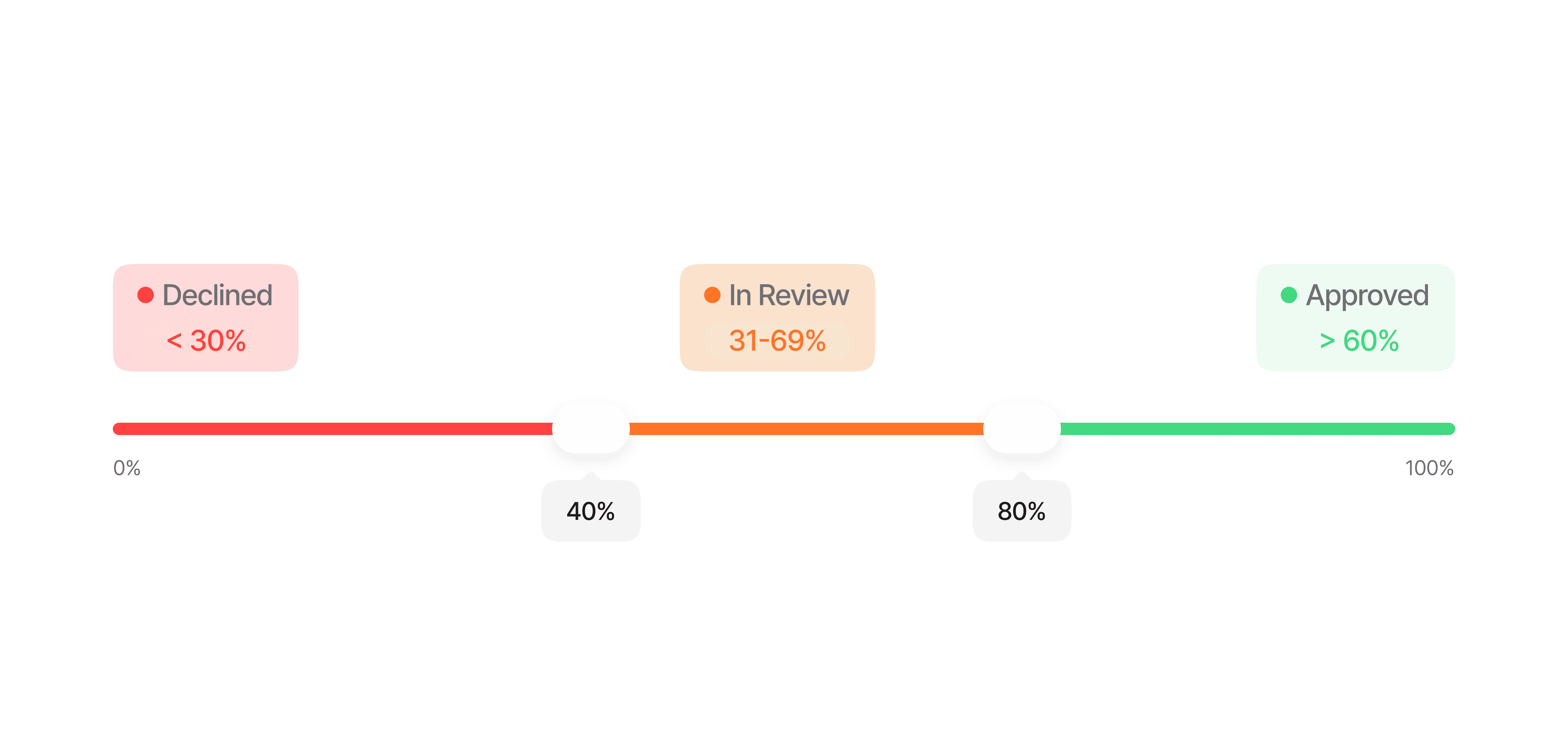
These thresholds can be adjusted based on your risk tolerance and security requirements, offering flexibility across use cases.
Retries & actionable feedback
In a Didit session, a liveness capture that fails for a fixable reason (poor lighting, face not centered, occlusion, a borderline score) does not immediately decline. The user is asked to retry with specific guidance, up to a configurable number of attempts.-
Attempt budget —
face_liveness_max_attemptscontrols the total number of liveness submissions per session. Default 3 (one initial attempt plus two retries), configurable per workflow node (range 1–3). -
Retry feedback — while attempts remain, a retryable failure keeps the user on the liveness step and returns a body carrying actionable
feedback_codes(the Web and Mobile SDKs surface these as coaching messages automatically): -
Retryable codes —
LOW_FACE_LUMINANCE(too dark),HIGH_FACE_LUMINANCE(too bright),NO_FACE_DETECTED,LOW_FACE_QUALITY,HIGH_FACE_OCCLUSION,LOW_LIVENESS_SCORE,MULTIPLE_FACES_DETECTED,AGE_NOT_DETECTED. -
Guaranteed retry for capture conditions —
LOW_FACE_LUMINANCE,HIGH_FACE_LUMINANCE,LOW_FACE_QUALITY,HIGH_FACE_OCCLUSIONandNO_FACE_DETECTEDdescribe the room the user is standing in, not the person. When an attempt fails on those codes alone, the user always gets a second attempt with the coaching message above, even on a workflow configured withface_liveness_max_attempts: 1. Every other code still follows the configured budget exactly. -
Exhaustion & fraud — once the budget is exhausted the computed status is applied (
DeclinedorIn Review). Confirmed presentation attacks (LIVENESS_FACE_ATTACK), blocklist hits and duplicate faces decline immediately and are never retried.
Retries apply to the session flow only. The standalone
POST /v3/passive-liveness/ endpoint is stateless and single-shot — it returns the result directly with no retry budget.How It Works
Video Selfie Capture
The user is guided through a simple, intuitive interface tailored to the selected liveness method.
Liveness Detection Analysis
Advanced algorithms process the captured media in real time to detect spoofing attempts. The analysis differs per method:
Multi-layered detection identifies presentation attacks including photos, screens, masks, and deepfakes.
3D Action & Flash
3D Action & Flash
- Verifies the user’s action (e.g., blink or nod) to confirm it’s performed correctly and live
- Analyzes light pattern reflections to validate the face’s three-dimensional structure
- Uses deep learning to assess micro-expressions and other behavioral cues
- Combines behavioral + physical signals for the strongest spoof resistance
3D Flash
3D Flash
- Processes a sequence of light pattern reflections at 30+ FPS to build a detailed depth map
- Confirms the face’s 3D properties, distinguishing it from flat or 2D spoofs
- No user interaction required — fully passive from the user’s perspective
Passive Liveness
Passive Liveness
- Applies deep learning to a single frame to detect texture patterns and artifacts
- A convolutional neural network (CNN) validates facial features and identifies anomalies
- Fastest method — works with a single photo capture
Result Processing & Verification
The system compares the liveness score against your configured thresholds and delivers results instantly.
Results are delivered via API response, webhook, or viewable in the Business Console with detailed audit logs for compliance.